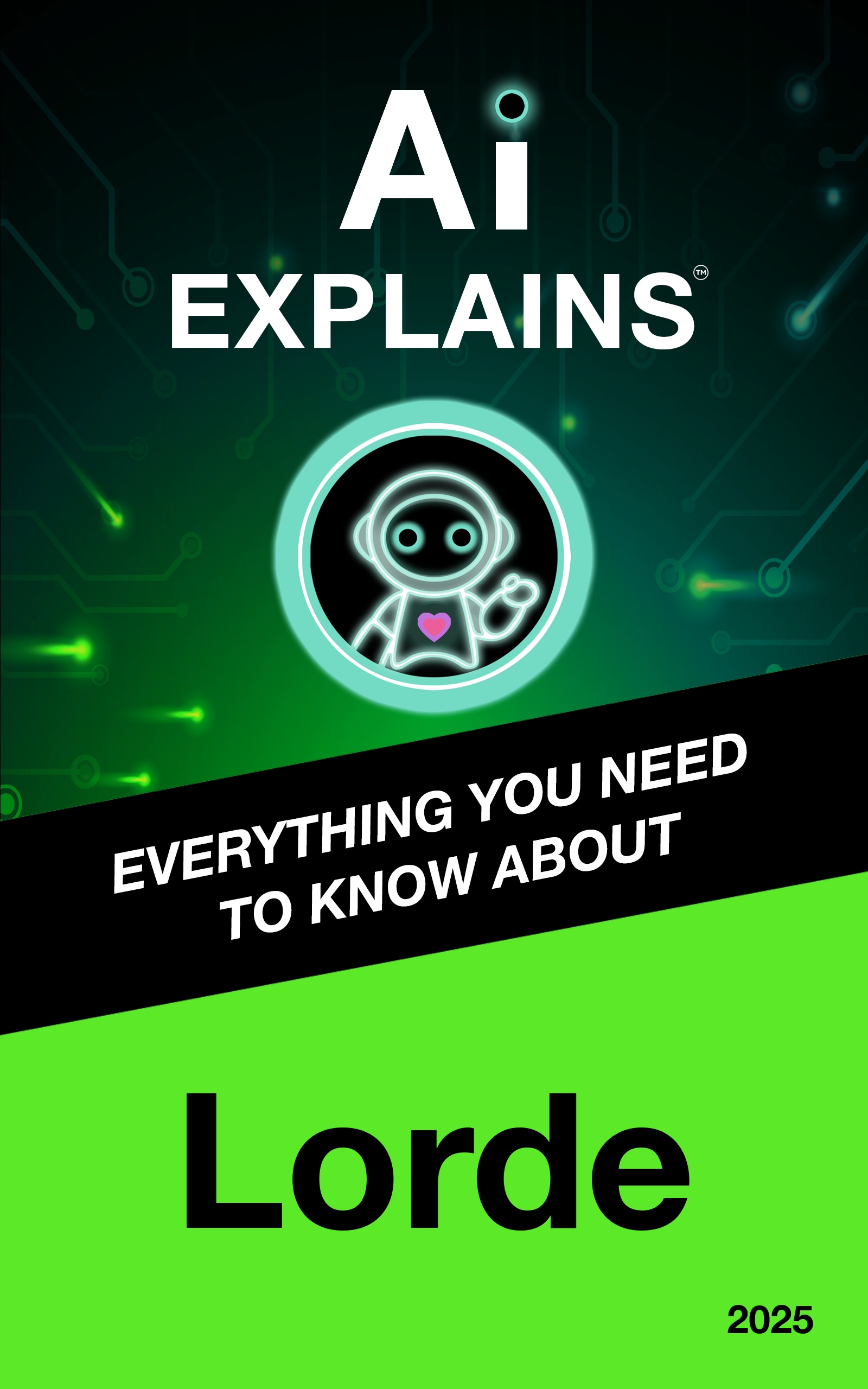
This page provides a concise overview of "Lorde (2025)" from the AI Explains series, including a summary and where to buy it.
AI Explains Series
Lorde (2025)
"AI Explains: Lorde" by Alexis Piani offers an in-depth analysis of Ella Yelich-O'Connor’s transformative music career, exploring her artistic evolution from minimalist electropop to psychedelic folk. The book examines her literary influences, cultural impact, and advocacy, highlighting how her intellectual depth and innovative reinventions shaped modern pop and inspired a new generation of artists. It provides critical insights into her genre-defying work and her role as a cultural and social pioneer.
About the Book
Written by: Alexis Piani.
Copyright (2025) Blue Tensor, L.L.C.
548 Market St, PMB 287551,
San Francisco, California 94104-5401
USA
About 'AI Explains: Lorde'
In 2013, a sixteen-year-old from a quiet suburb of Auckland, New Zealand, released a song that fundamentally altered the sound of global pop music. That artist, Ella Yelich-O'Connor, known as Lorde, did not conform to the industry’s expectations. She rejected the high-gloss spectacle and vocal theatrics of her peers, offering instead a sound defined by skeletal electronic beats, a deep contralto voice, and lyrics steeped in literary cynicism. Her debut, Pure Heroine, was not just a commercial success—it was a manifesto that validated introspection and intellectual depth in the mainstream, earning her two Grammy Awards and establishing her as the definitive voice of a skeptical generation.
This book is an exhaustive exploration of Lorde’s multifaceted career, tracing her evolution from a prodigious, gifted child identified through cognitive testing in Auckland to a sophisticated Art Pop auteur and cultural advocate. We move beyond the familiar narrative of her breakthrough to analyze the rigorous intellectual foundation of her work, examining how her poet mother and literary influences like T.S. Eliot and Sylvia Plath shaped her lyric-driven songwriting process. We dissect the radical sonic shifts across her discography—from the minimalist electropop of Pure Heroine to the maximalist, piano-driven chaos of Melodrama, and the psychedelic folk of Solar Power—revealing how each album was a deliberate, necessary artistic reinvention. For instance, we detail the complex, four-year process behind Melodrama, structured entirely around the emotional arc of a single house party, a metaphor she used to translate personal heartbreak into universal, theatrical art.
Crucially, we examine her profound cultural impact, detailing how her unconventional stage presence and outspoken feminist views pioneered a new archetype for female artists, directly influencing the aesthetic and thematic choices of subsequent stars like Billie Eilish and Olivia Rodrigo. The book also delves into her complex public persona, including her high-stakes geopolitical advocacy, such as the cancellation of her Tel Aviv concert, and her commitment to cultural stewardship, exemplified by her Te Reo Māori project, Te Ao Mārama. This project, where she re-recorded five songs in the indigenous language of New Zealand, was a powerful, non-commercial act of linguistic activism, demonstrating her commitment to using her global platform for meaningful social change.
This is not merely a biography; it is a critical analysis of an artist who consistently challenged the boundaries of her genre. Readers will gain a deep understanding of how Lorde leveraged her intellectual rigor and unwavering artistic control to become a cultural architect, shaping the sound and conscience of contemporary music. This book is essential reading for music critics, aspiring songwriters, and anyone seeking to understand the forces that defined 2010s alternative pop and continue to influence the music landscape of today.