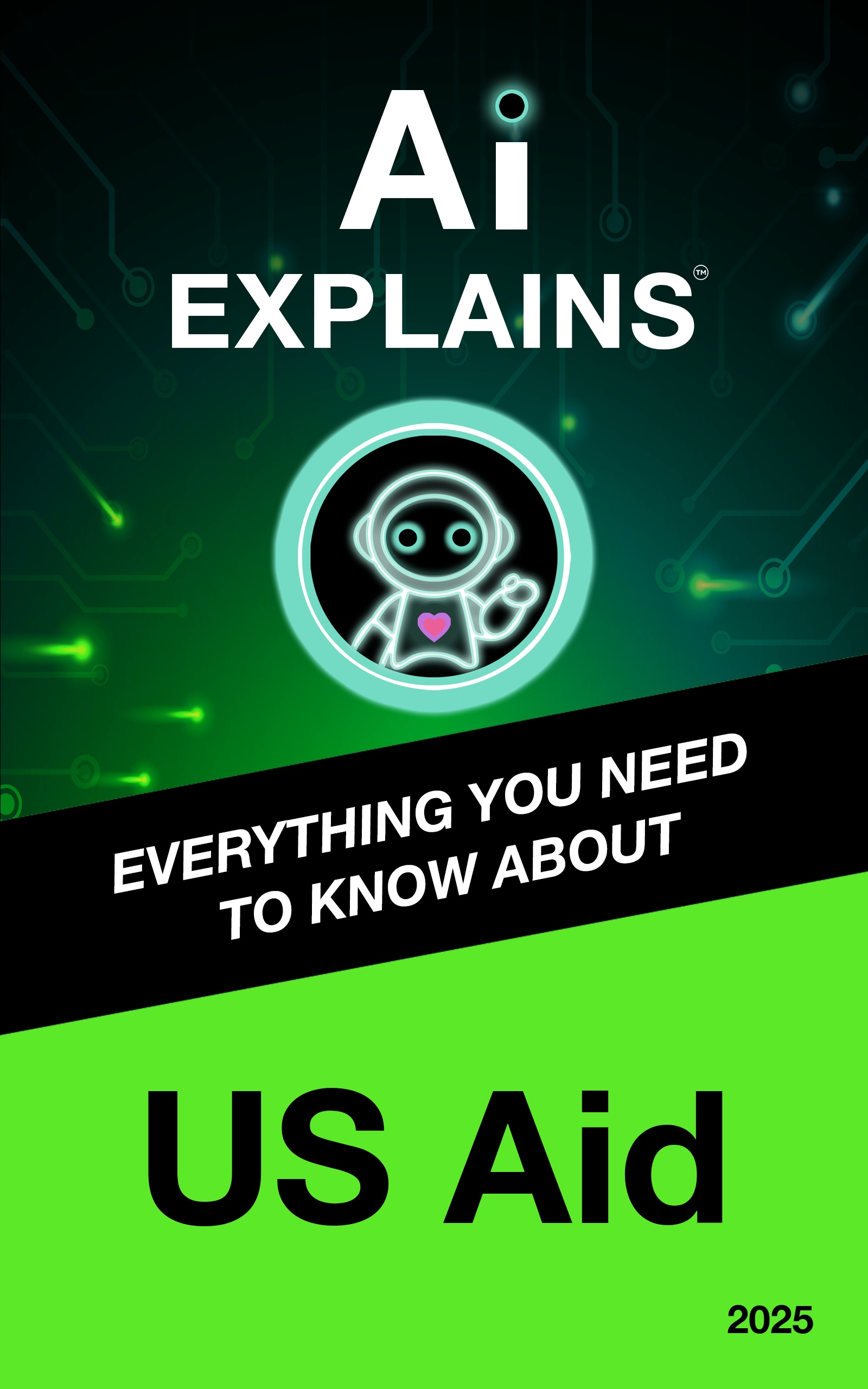
This page provides a concise overview of "US Aid (2025)" from the AI Explains series, including a summary and where to buy it.
AI Explains Series
US Aid (2025)
"AI Explains: US Aid" by Alexis Piani examines the complex history and strategic role of USAID, highlighting its evolution from a Cold War creation to a vital instrument of American soft power. The book critically explores its operational structure, successes like PEPFAR, and ethical dilemmas, culminating in the 2025 political challenges that threatened its independence. It offers an in-depth, data-driven analysis of how U.S. aid shapes global stability, morality, and geopolitics.
About the Book
Written by: Alexis Piani.
Copyright (2025) Blue Tensor, L.L.C.
548 Market St, PMB 287551,
San Francisco, California 94104-5401
USA
About 'AI Explains: US Aid'
The United States Agency for International Development (USAID) is often misunderstood, viewed either as a purely charitable organization or as an inefficient bureaucratic relic. The truth is far more complex: USAID is one of the most sophisticated, strategically vital, and perpetually controversial instruments of American power, operating at the intersection of global morality and geopolitical necessity. This book pulls back the curtain on the agency’s six-decade history, revealing how a Cold War creation, conceived by President Kennedy in 1961 to counter Soviet influence, evolved into a global force in health, governance, and economic stability—and why its very existence remains a constant political battleground.
This is not a sanitized institutional history, but a critical examination of the agency’s triumphs and its profound ethical dilemmas. We move beyond the headlines to explore the operational architecture that allows American aid to function, detailing the decentralized network of country missions that manage billions of dollars, and the intricate funding pipeline that begins with a fierce annual fight in Congress. You will gain a deep understanding of how USAID’s technical expertise saved millions of lives through programs like PEPFAR, and how its economic strategies evolved from the Green Revolution’s technological fixes to modern, market-driven resilience. Crucially, we dissect the agency’s role as a strategic asset in the 21st century, analyzing how U.S. development dollars are deployed to stabilize fragile states like Ukraine and Syria, and how the American model of conditional, transparent aid competes directly with the transactional, debt-laden infrastructure blitz of rising global powers like China.
The book culminates in a detailed analysis of the agency’s near-death experience in 2025, when political shifts and executive action threatened to dismantle its independence. We reveal the legal arguments that protected the agency’s statutory mandate against executive overreach, and the profound institutional trauma that followed the attempt to absorb its specialized functions into the State Department. For instance, the Executive Order of 2025, while preserving popular Global Health programs, specifically froze funds for democracy promotion and climate initiatives, demonstrating the political calculus behind the attack on the agency’s ideological mission. This book is essential reading for policymakers, development professionals, students of international relations, and any citizen seeking an honest, data-rich assessment of how America wields its soft power, illuminating the high-stakes trade-offs inherent in using aid as both a tool of foreign policy and a moral commitment to global development.