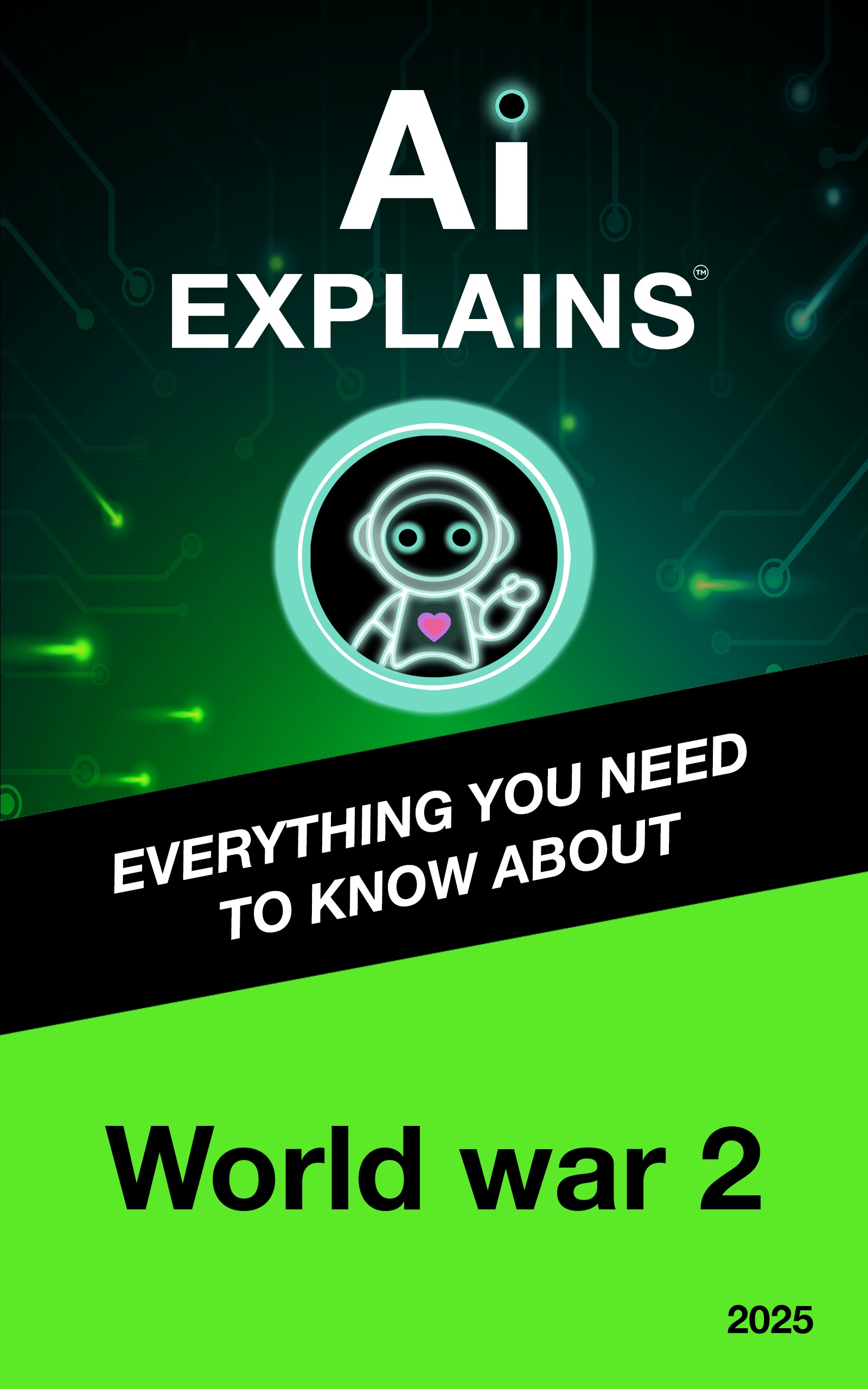
This page provides a concise overview of "AI Explains: World war 2" from the AI Explains series, including a summary and where to buy it.
AI Explains Series
AI Explains: World war 2
This comprehensive account of World War II explores its complex ideological, technological, and geopolitical dimensions, highlighting key battles, strategic failures, and innovations. It examines how economic despair and totalitarian regimes fueled global conflict, detailing pivotal campaigns, intelligence breakthroughs, and the war’s profound aftermath, including the Cold War and Holocaust. The book offers deep insights into the interconnected events shaping the modern world, providing clarity and depth for students and enthusiasts alike.
About the Book
The Second World War was not a single conflict, but a convergence of ideological crusades, resource wars, and technological revolutions that consumed the globe. It was a conflict defined by extremes: the lightning speed of the German Blitzkrieg in 1940, the agonizing 872-day siege of Leningrad, the vast, brutal attrition of the Eastern Front, and the terrifying, instantaneous destruction of the atomic age. To understand this pivotal era is to grasp not only the grand strategies of figures like Churchill, Roosevelt, and Stalin, but also the intricate, often unseen, factors that determined the ultimate outcome. This book moves beyond the familiar narratives of D-Day and Pearl Harbor to synthesize the political, military, and technological dimensions that shaped the war’s course, revealing the profound interconnectedness of events fought thousands of miles apart.
We begin by tracing the lethal combination of national humiliation and economic despair left by the Treaty of Versailles and the Great Depression, which provided the perfect crucible for the rise of expansionist totalitarian regimes. We then follow the war’s momentum as it shifts dramatically across three global theaters. You will gain a deep understanding of how the strategic failures of the Axis—such as Hitler’s fatal decision to divert forces from Moscow to secure the resources of Ukraine, a move that cost him the 1941 campaign—were mirrored by the Japanese command’s overconfidence at Midway, a battle won by American codebreakers who knew the enemy’s plans in advance. This book details the sheer scale of the Soviet defense, which absorbed the bulk of the German war machine, and the logistical genius of the Western Allies, whose industrial output—including the fact that the U.S. was launching vital cargo ships in less than a week by 1944—proved insurmountable.
This is a history for those who seek clarity and depth in a complex subject. Whether you are a student of military history, a dedicated enthusiast, or a reader seeking to understand the origins of the modern world, this book offers a comprehensive, authoritative account. It is designed to provide the necessary context to understand the ideological battles that fueled the conflict, the technological innovations that defined it, and the geopolitical consequences that followed, including the emergence of the Cold War and the moral reckoning of the Holocaust. By integrating detailed case studies of major campaigns with the crucial, often hidden, role of intelligence and technology, this work ensures that the lessons of World War II remain vivid and relevant, providing a complete picture of the war that shaped the twentieth century.